FORD · INDUSTRY NEWS
By Nessa Halden
·
·
7 MIN READ
A $28,350 electric pickup sounds like the sort of number that belongs in a concept presentation, not on a dealer window. Ford says otherwise. The Fathom, due in 2027, will start there with its standard-range battery. Add the announced $1,595 destination charge and the cheapest version lands at $29,945 before tax, registration, accessories, or whatever a dealer decides the first scarce trucks are worth.
That still puts it within a few hundred dollars of a Maverick Hybrid, which is precisely the point. Ford is not trying to make the least expensive electric truck. It is trying to make an electric truck ordinary buyers can cross-shop against a gasoline or hybrid vehicle without first explaining away a five-figure price gap.
The catch is that Ford has shown us more of the arithmetic than the truck. Fathom now has a name, a base price, a factory, and a rough description of its mission, but no final range estimate, charging curve, payload rating, bed dimensions, or public production vehicle. For now, the most interesting object is not the pickup itself. It is the system Ford believes can build one profitably.
THE CHEAP TRUCK IS NOT SUPPOSED TO FEEL CHEAP
Fathom is described as midsize, although Ford says its exterior footprint is closer to the compact Maverick. The clean-sheet EV layout is supposed to create more passenger volume than a Toyota RAV4, with seating for five, a front trunk, and a conventional pickup bed. Ford also says every truck will be BlueCruise-capable and include a large high-resolution display, digital key, Apple CarPlay and Android Auto compatibility, and bidirectional power capability.
That list matters because it reveals Ford’s answer to the stripped-down electric pickups arriving from startups. The company is betting that an affordable vehicle still has to feel complete when a buyer uses it every day. A low base price gets someone onto the configurator; a useful cab, a bed, winter-friendly controls, and charging that fits a real routine are what keep the truck from becoming a novelty.
The platform uses a 400-volt architecture rather than chasing the headline charging speeds possible with 800 volts. Ford’s public explanation is blunt: for this vehicle’s energy needs, the extra cost and complexity were not worth it. The company is targeting roughly 300 miles for some customers through lower weight, better aerodynamics, and a smaller battery rather than simply adding more cells. Fathom will use a NACS port, with adapters planned for CCS fast chargers and J1772 home equipment.
There is a sensible product idea in there. There is also a lot we cannot score yet. A 300-mile target is not an EPA rating, BlueCruise capability does not tell us the subscription cost, and bidirectional power is only valuable once Ford explains the required home hardware and pricing.
THE FACTORY IS PART OF THE PRODUCT
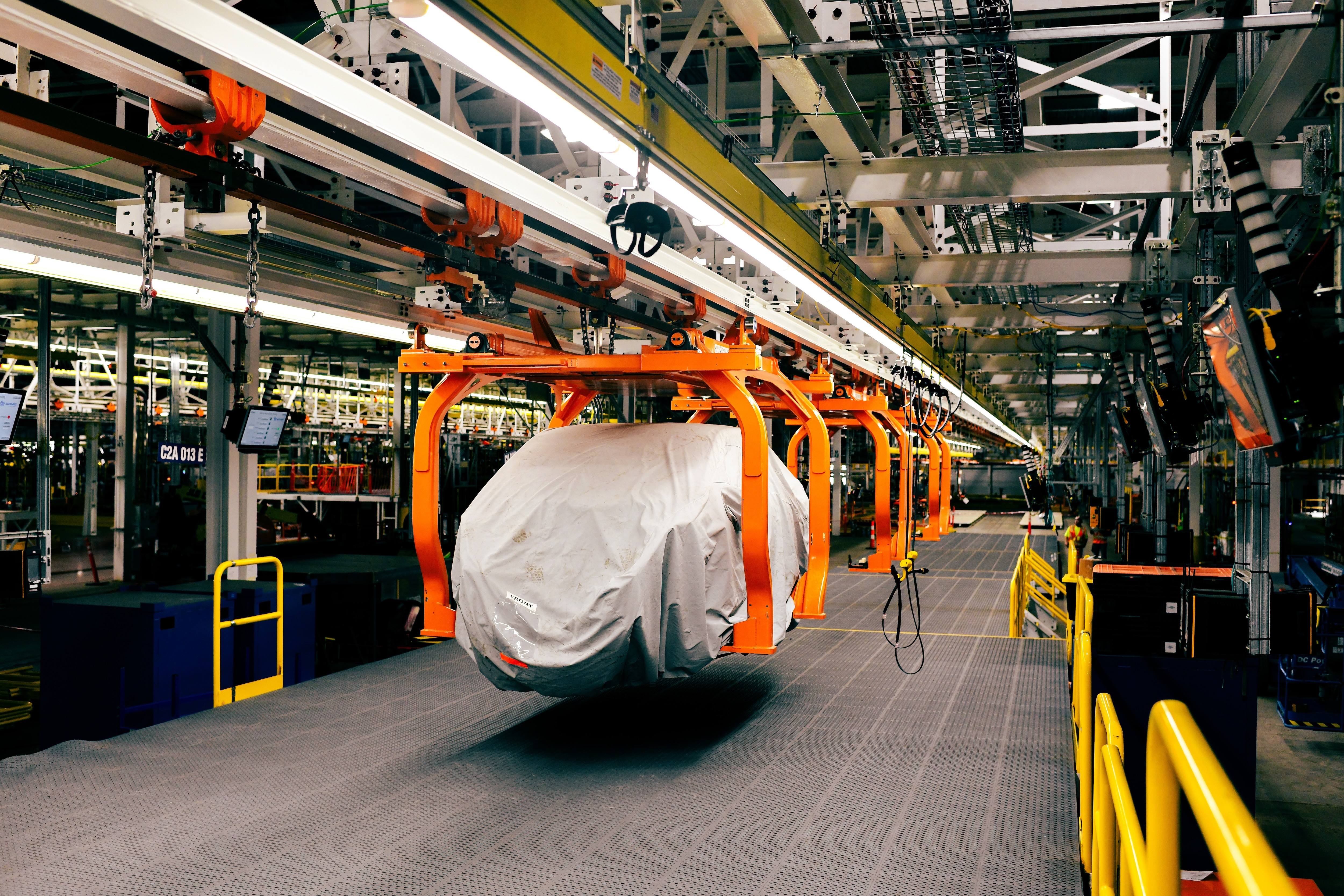
Louisville Assembly Plant went quiet in late 2025 so crews could strip out the old production equipment. Ford says the $2 billion overhaul left a three-million-square-foot shell ready for a different way of assembling a vehicle. Production-qualified Fathom prototypes are scheduled to begin in the first quarter of 2027, with customer trucks later in the year.
Instead of moving one nearly complete body down one long line, Ford’s assembly tree builds three large sections in parallel: a front clip, a rear clip, and the structural battery floor. Seats and interior parts can be installed on open assemblies before those sections meet. Workers get better access to fasteners and components; the vehicle spends less time moving past stations that can only work on one small area.
This is not factory theater. The truck’s large front and rear aluminum castings replace groups of stamped and welded pieces. Its wiring harness is more than 4,000 feet shorter and 22 pounds lighter than the one in Ford’s first-generation electric SUV. Ford says the process reduces reaching over a fender by 84 percent and can assemble the vehicle 40 percent faster before some of that time is reinvested in automation, in-house work, and quality checks. The claimed net improvement is 15 percent.
Those are unusually physical explanations for a vehicle price. Shorter wire means less copper, fewer connectors, less installation time, and fewer places for a fault to hide. Open subassemblies mean workers do not have to feed a seat through a door opening or work blind behind a dashboard. Private 5G and Wi-Fi 7 sound like corporate garnish until they are used to flash and test modules before those modules disappear inside a finished truck.
THE MISSING NUMBERS WILL DECIDE THE STORY
Fathom’s starting price is real enough to reset expectations, but the base truck has to exist in meaningful volume. Automakers have a long history of advertising an attractive entry trim, then stocking dealers with larger batteries, appearance packages, and driver-assistance subscriptions. The useful question is not whether one customer can order a $28,350 truck. It is what percentage of Fathoms leave Louisville close to that number.
Range and charging will matter differently here than they do on a six-figure performance EV. A household buying Fathom as a commuter, work vehicle, or second car may accept a modest battery if overnight charging is easy. A buyer who expects to tow, cover rural distances, or park without home charging will care much more about the 10-to-80-percent time, cold-weather range, and how sharply efficiency falls with a loaded bed.
Payload, repair cost, insurance, and battery warranty could be just as important. Large castings reduce part count in the factory, but owners will want to know what happens after a curb strike or collision. Ford says it designed the unicastings with repair and insurance input and that the structural battery is serviceable, although individual cells will not be replaceable. Those claims need to survive body-shop estimates, not just engineering presentations.
For now, Fathom is the most credible affordable-EV pitch Ford has made because the company is treating manufacturing cost as part of the vehicle, not as an accounting problem to solve after design freeze. The $28,350 headline earned attention. The first dealer invoices, winter range tests, and collision repairs will tell us whether the factory actually earned the price.
SOURCES & VERIFICATION
Ford Fathom product announcement and pricing — Ford, August 6, 2026
Louisville Assembly Plant production-system update — Ford, August 13, 2026
Pricing and destination-charge context — Axios, August 6, 2026
NH
Nessa Halden
Roadside Power Lab's industry editor, covering automaker strategy, product planning, and what new vehicles mean for owners.

LUCID · RECALL
LUCID RECALLS 27,185 AIR SEDANS OVER A LOW-VOLTAGE FIRE RISK
A software-controlled exterior-lighting circuit may overheat, disable the lights and create a fire risk. Owners are being told to park outside until the update is installed.
·


ROADSIDE POWER LAB
In-depth coverage for the power systems that keep cars moving.
© 2026 ROADSIDE POWER LAB