RPL · ROADSIDE POWER LAB FIELD GUIDE
Certification, weather protection, and ownership: four top CCS to NACS adapters compared, and the one we’d keep in the car.
By Evan Larson | Gear & Testing Editor | Updated September 11, 2026


PUBLIC FAST CHARGING IS WHERE AN ADAPTER EARNS ITS PLACE
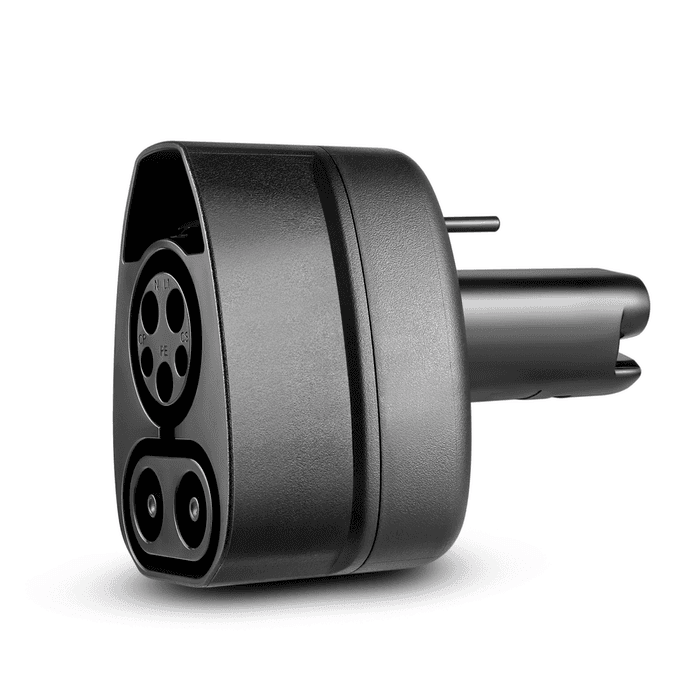
A CCS-to-NACS adapter can give a compatible Tesla or newer NACS-equipped EV access to thousands of additional DC fast-charging locations. The four adapters reviewed here all perform that basic job, but they differ significantly in safety verification, weather protection, charging capacity and long-term compatibility. Those differences matter because the adapter becomes the physical connection between a high-powered public charger and the vehicle while carrying hundreds of amps outdoors.
Compare the published limits, certification, enclosure protection and ownership terms that separate these four adapters.
Manufacturer-published ratings describe adapter limits; the vehicle and charging station determine delivered power. Tesla publishes a 1,000V rating and advertises charging up to 250kW, but does not publicly state a current rating. The published IP ratings cover different configurations and are not scored as a like-for-like measure of protection while charging.


Roadside Power Lab is published by Dropcases LLC. Coverage may include affiliate links or products from affiliated companies.
Four factors separate a dependable fast-charging adapter from one that simply fits the port:
SAFETY CERTIFICATION
Whether the complete adapter has passed UL 2252, the dedicated safety standard for EV charging adapters.
WEATHER PROTECTION
How well the enclosure resists dust, rain, snow, road spray and moisture.
CHARGING CAPABILITY
Whether its voltage, current and power limits suit current Teslas and newer high-voltage NACS vehicles.
COMPATIBILITY & OWNERSHIP
Which vehicles it supports, whether additional hardware is required and what warranty coverage is included.


Lectron is our top pick for the strongest overall buying value. Its UL 2252 certification and 1,000V / 500A rating provide documented safety verification and electrical headroom. IP67 protection for the standalone adapter, a competitive current price, a two-year limited warranty on direct purchases and explicit NACS/J3400 support complete the package.
Its 1,000V / 500A rating provides electrical headroom for compatible high-voltage NACS vehicles. Actual charging speed is set by the vehicle and station, not the adapter rating alone.
Lectron lists an IP67 rating for the standalone adapter. That means it is dust-tight and tested against temporary immersion—a higher level of dust and water-ingress protection than IP44 or IP54. It is a meaningful advantage for an adapter carried in a car and handled outdoors, but the rating does not mean a wet connection is safe to use. Keep the contacts clean and dry, and follow the charging instructions.
Lectron’s SGS certification to UL 2252 is a substantive safety credential. UL 2252 is written specifically for EV charging adapters and calls for testing of heat buildup, electrical insulation and durability—not merely a manufacturer’s claim that a product is “safety tested.” That independent assessment gives a concrete reason for confidence in an adapter used for high-power charging. Lectron also states support for compatible Tesla vehicles and newer NACS/J3400 EVs. Direct purchases carry a two-year limited warranty, versus one year for Tesla and EVBASE.
PROS
•
UL 2252 certified by SGS
•
IP67 rating for the standalone enclosure
•
Rated for 1,000V / 500A with explicit J3400 support
CONS
•
Costs more than EVBASE and Hansshow
•
Actual charging speed still depends on the vehicle and station
•
No included hard storage case
BEST FOR: Drivers who use public fast chargers regularly, charge in varied weather or want one adapter that can remain useful with a future NACS vehicle.

Tesla is the straightforward factory choice for Tesla owners. Its strongest selling point is clarity about fit. Owners can check CCS compatibility for their specific vehicle in the Tesla app, and supported older cars have a retrofit path. That removes a meaningful source of uncertainty before purchase, especially for drivers who want an official accessory and a clear route to support. The limitation is just as important: eligibility is vehicle-specific, so owners should confirm compatibility rather than assume every Tesla can use the adapter.
Its published specifications support serious fast-charging use, but they need context. Tesla lists a 1,000V rating and IP44 enclosure protection, and advertises charging at up to 250kW. That advertised speed is an upper limit, not what every stop will deliver: the vehicle, battery conditions and charging station determine the actual rate. Tesla also does not publicly state a current rating for the adapter, so its voltage rating should not be turned into an unsupported peak-power claim.
PROS
•
Factory accessory for supported Tesla vehicles
•
Compatibility check through the vehicle or Tesla app
•
Retrofit support for certain older vehicles
CONS
BEST FOR: Tesla owners who prefer the official purchase path or need Tesla to check CCS compatibility and arrange a retrofit.

EVBASE is the least expensive adapter in this comparison. For someone who expects only occasional CCS charging, the lower price is its main attraction.
Its IP54 enclosure protects against most dust and splashing water. EVBASE also publishes temperature monitoring and thermal cut-off behavior, but UL 2252 certification for the complete adapter is not publicly stated.
PROS
•
Lowest purchase price in the group
•
IP54 protection against most dust and splashing water
•
Published temperature monitoring and thermal cut-off behavior
CONS
BEST FOR: Price-sensitive Tesla owners who expect occasional use and are comfortable with less complete published documentation.

Hansshow’s adapter is primarily useful for a specific compatibility problem: it offers an optional retrofit path for select 2018–2021 Model 3 vehicles that lack native CCS adapter support.
It is rated for 500V / 300A, with advertised charging output between 150 and 180kW. At a high-output station, that ceiling can limit the strongest portion of a charging session.
PROS
•
Retrofit route for certain 2018–2021 Model 3 vehicles
•
Lower purchase price than Lectron and Tesla
•
Published 500V / 300A electrical limits
CONS
BEST FOR: Owners of eligible older Model 3 vehicles who need the available retrofit solution and accept a lower charging ceiling.
WHAT THE SPECS ACTUALLY MEAN
UL 2252 targets the failure points that matter most in a high-powered charging adapter: contacts that become too hot, insulation that fails to contain the voltage, connectors that do not remain securely locked and protective systems that fail to respond when something goes wrong.
To pass, the complete adapter must remain within defined electrical, thermal and mechanical safety limits—not merely contain a few individually recognized components.
For buyers, this makes UL 2252 substantially more meaningful than broad claims such as “safety tested,” “built to UL standards” or “made with UL-recognized materials.” Certification provides independent evidence that the finished product has passed the adapter-specific standard under demanding conditions.
For this comparison, we give independently verified UL 2252 certification greater weight than general claims such as “safety tested” or “built to UL standards.” If we could not verify current UL 2252 certification in a manufacturer’s public materials, we mark it as “not publicly stated.” This does not mean the adapter is unsafe or untested, only that we could not verify certification to this specific standard.
Documented incidents involving uncertified DC charging adapters have included overheating and arcing, with the potential to damage charging equipment or the vehicle.
SAE J3400 is the official industry standard for the Tesla-style connector commonly called NACS. The same port is now being adopted by newer EVs from other automakers, including vehicles with higher-voltage charging systems.
Explicit J3400 compatibility indicates that an adapter is intended for this broader generation of NACS vehicles. Tesla’s current adapter is also rated for 1,000V, but Tesla specifies it for Tesla vehicles only. Check your automaker’s guidance before using any adapter with a non-Tesla EV.
A fast-charging adapter carries high-voltage power outdoors, where rain, snow, dust and wet pavement are part of normal use. Moisture or debris around the connection can contribute to corrosion, poor contact and excess heat.
IP stands for Ingress Protection. The first digit describes protection from dust and solid objects; the second describes protection from water. Higher numbers indicate a more tightly sealed enclosure.
• IP67 — 6 means dust-tight; 7 means tested against temporary water immersion for the standalone adapter. Lectron publishes this rating, but it does not by itself rate the connector junctions during an active charging session.
• IP54 — 5 means protected from most dust; 4 means protected from splashing water. It can handle ordinary outdoor exposure and road spray, but should not be soaked, dropped in a puddle or stored wet.
• IP44 — 4 means protection from larger solid objects; 4 means splash resistance. Tesla’s current U.S. manual publishes this rating. Because the published IP figures cover different configurations, we do not score one as better protected while charging.
The rating applies to the enclosure. The terminals should still be inspected and kept clean before every charging session.


Not every Tesla can accept CCS charging without additional hardware. On the touchscreen, open Controls → Software → Additional Vehicle Information and look for “CCS Adapter Support: Enabled.” Owners of other NACS/J3400 vehicles should confirm that their manufacturer permits CCS fast charging through an adapter.
SOURCES & SPECIFICATION NOTES
Specifications, prices, compatibility notes, certification claims and warranty terms were checked against current product pages and policies from Lectron, Tesla, EVBASE and Hansshow in September 2026. Tesla’s manual lists 1,000V and IP44, and its shop page advertises charging up to 250kW. We could not verify a public Tesla current rating or UL 2252 certification in its product materials. Published IP ratings are not scored as a like-for-like measure of protection while connected. Prices can change. Roadside Power Lab may receive compensation from qualifying purchases, but rankings are based on the criteria above.
EL
EVAN LARSON
Gear and Testing Editor focused on EV charging hardware, roadside tools, and the ownership details that matter after checkout.

TRUCK TIRES · COMPARISON REVIEW
PORTABLE TIRE INFLATORS ON A 33-INCH TRUCK TIRE
Which designs are actually sized to finish the job—and which are only useful for top-offs.
By Evan Larson · August 17, 2026

SUV CARGO · COMPARISON REVIEW
ROOFTOP CARGO BOX VS. HITCH-MOUNTED CARGO BOX
Fuel, wind noise, loading effort, parking and weather protection compared.
By Dorian Keel · August 17, 2026

JUMP STARTERS · REVIEW
THE 4 BEST PORTABLE JUMP STARTERS FOR CARS, SUVS & TRUCKS
Four thousand peak amps, four contenders, and the specs that actually decide which pack earns trunk space.
By Evan Larson · August 13, 2026
ROADSIDE POWER LAB
In-depth coverage for the power systems that keep cars moving.
© 2026 ROADSIDE POWER LAB